
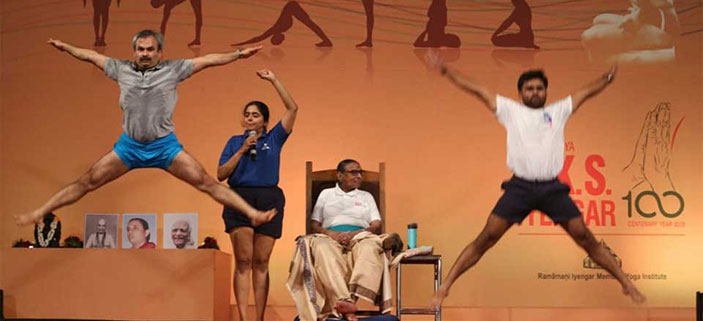
Jumping into Spring: The Dynamic Side of Iyengar Yoga
9th March 2026
As winter loosens its hold and the energy of spring begins to rise, many of us feel a subtle shift for movement, fresh beginnings, and dynamic engagement with life. In nature, spring is a time of growth and renewal. In our practice, this energy finds expression in a powerful facet of the Iyengar tradition: its dynamic practice.
Iyengar Yoga has many sides to it. It is not only long-held postures or restorative work. It is not only props. The way we practice and move depends on who we are teaching. One of the clearest expressions of this dynamic intelligence is found in the classical jump back and jump through practices seen vividly in the early black-and-white films of B.K.S. Iyengar himself.
These movements embody the transition between postures, linking the grounded stability of standing poses with the lightness and readiness of seated poses or inversions. They remind us that yoga is both art and science.
Watch a classic example below: Part 1 of 6:
What Is “Jumping” in Iyengar Yoga?
In the Iyengar tradition, jumping practice refers to a set of transitional movements — often performed after standing asanas — where the practitioner lifts the body from one form into another through a precise transfer of weight and coordinated action.
Common examples include:
- Jump back: from Dandasana to Chaturanga Dandasana or Adho Mukha Svanasana
- Jump through: from Adho Mukha Svanasana back to a seated position
In early footage, students (and Mr. Iyengar himself) demonstrate these transitions with clarity, rhythm, and remarkable stability.
This dynamism counters the common myth that Iyengar Yoga is slow or static. It shows that precision and vitality are not opposites, they are partners.
Why Jumping Matters?
1. Builds Strength and Coordination
Jumping the Iyengar way develops strength and focus simultaneously. Physically, it improves muscle tone and circulation throughout the body. Neurologically, it enhances coordination and timing. Rather than isolating muscles, this work strengthens the entire kinetic chain supporting balance, arm work, inversions, and overall resilience.
It requires:
- engaged legs
- strong core integration
- active arms and shoulders
- intelligent weight transfer
- breath awareness
2. Deepens Breath–Movement Coordination
Exhalation often initiates movement. Inhalation supports lift and extension. This intelligent coordination creates both power and control. While many classes emphasise “normal breathing,” there is also space within yogic tradition for longer, regulated breathing patterns.
3. Invites Joy and Lightness
“A sense of flight brings a sense of delight.”
Jumping practice introduces an element of lift, physically and emotionally. The experience of rooting, lifting, centring, and landing with control creates buoyancy. This quality mirrors the upward energy of spring itself.
A Classical Dynamic Sequence
In Light on Yoga, B.K.S. Iyengar presents a dynamic sequence for those wishing to develop the arms and chest and practise a form of Sūryanamaskār:
- Tādāsana
- Uttānāsana — jump to
- Chaturanga Daṇḍāsana
- Ūrdhva Mukha Śvānāsana — return to
- Chaturanga Daṇḍāsana
- Adho Mukha Śvānāsana — jump to
- Uttānāsana
- Tādāsana
He suggests beginning with six rounds and increasing according to capacity, see a similar sequence below.
Breathing is coordinated carefully – inhalations lifting and opening, exhalations grounding and transferring weight.

In the book Yoga for Sports by B.K.S Iyengar we have two sequences for agility which Svenja Karstens has illustrated. The model in the illustrations is Angelo Cecchi, who has been practising yoga since 2004. Since 2014 he has been studying and teaching at Patanjala Yoga Kendra in Rishikesh, spending part of each year there with Usha Devi and the rest travelling to teach internationally.

If you’re curious about how Iyengar Yoga can support you, find a qualified teacher near you here:
Teachers: Get Involved
If you are a teacher and would like to take part, we’d love to hear from you. Throughout March and April, you can:
- Share photos or videos of your own practice on social media, tagging @iyengaryoga_uk
- Contribute your reflections, teaching notes, or short articles on dynamic yoga by emailing us at content@iyengaryoga.uk.org
Together, we can build a rich collection of knowledge, inspiration, and practical resources for supporting students and teachers alike.
